
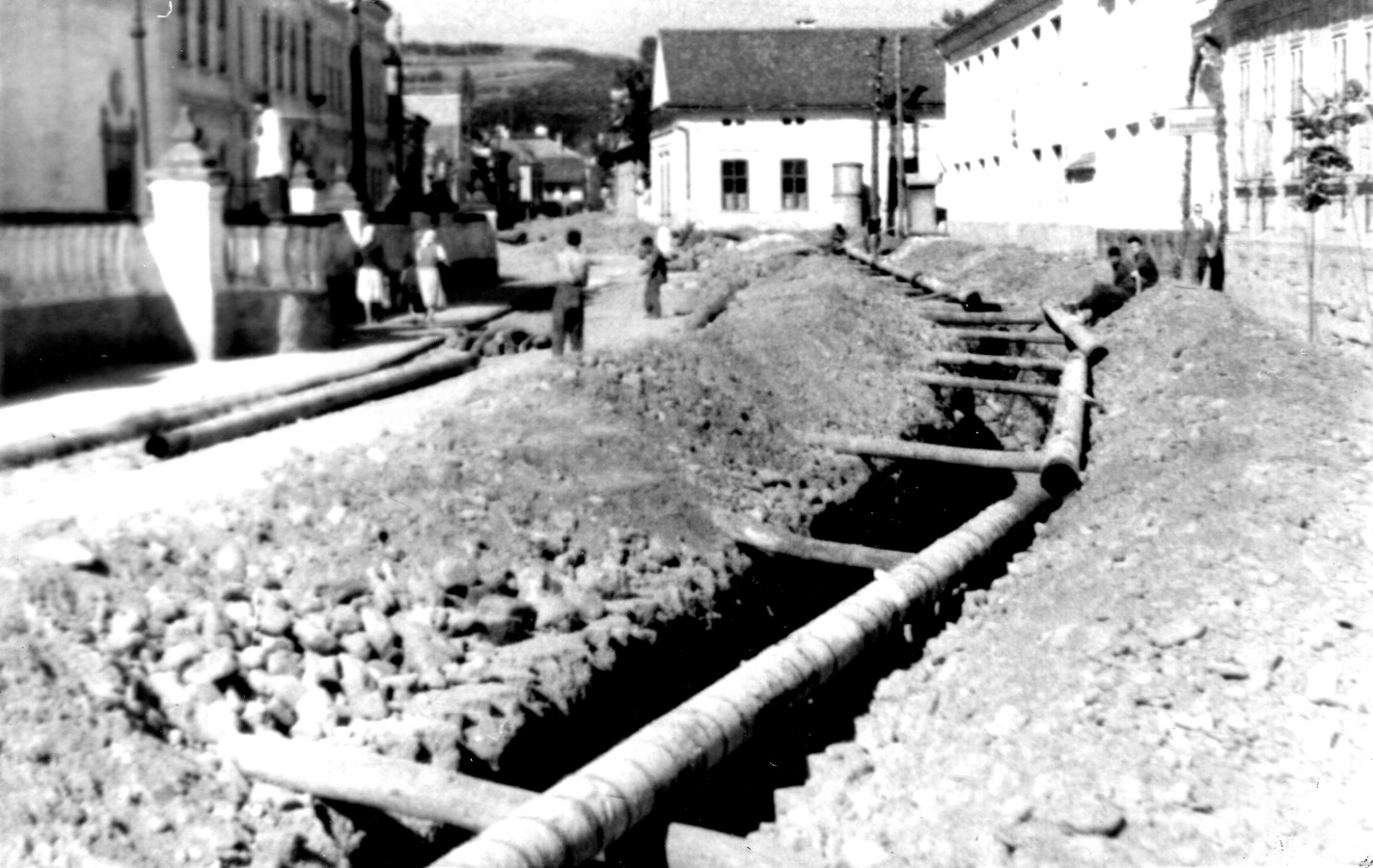
The photograph was likely taken in the late 1950s and shows the construction of the first water supply system in Gheorgheni. Ironically, despite the town being rich in springs and water, it was was unable to organize its water and sewer systems for an entire century. At the beginning of the 20th century, the town sold the vast Lapos-gó forest and deposited the proceeds-1,500,000 Austro-Hungarian crowns-for the planning and construction of a water and sewer network. However, during the Great War, the funds were reallocated as a war loan and were entirely lost.
During the 1938–39 renovation of the main square, pipes were already laid on the square and adjacent streets, but subsequent changes in rule and the war halted further progress. In 1956, Gheorghe-Gheorghiu Dej, visiting the town, ordered the resolution of this long-standing issue, leading to the start of planning and construction in 1957. By August 23, 1960, water was brought to the main square, and a small ceremony marked the beginning of water supply to part of the town.
Construction of the sewage system began in the 1970s and was operational by 1973. Both networks were continuously expanded until the 1980s. According to the records of Félix Blénessy, by 1980 the water supply network stretched 53,816 meters (including main, service, and distribution lines), serving 4,230 families or 14,500 people, in addition to industrial and other facilities. The sewer network reached a total length of 16,540 meters.